
Units and buildings
This page gathers the exact numbers the game uses. They are the same on both maps, except the income of European territories, which depends on their size.
The three units
Every soldier has an attack value, used when it is part of an army assaulting a territory, and a defense value, used when it holds a garrison.
| Unit | Attack | Defense | Strong vs | Weak vs | Produced by |
|---|---|---|---|---|---|
| Pikeman | 1 | 1.2 | Knights | Archers | Village, Barracks |
| Archer | 0.7 | 1.8 | Pikemen | Knights | Archery range |
| Knight | 2.2 | 1 | Archers | Pikemen | Stable |
The pikeman is the basic soldier: decent in attack and defense, produced in bulk. The archer is a defender, with the best defense in the game but a weak attack. The knight is the shock unit: more than twice a pikeman's attack, but a poor defense.
Counters: up to ±50%
In every battle, the value of each unit type is adjusted according to the composition of the opposing force. The bonus is 50% times the share of enemies the unit beats, minus the share of enemies that beat it. Against a garrison made only of archers, your knights count for 1.5 times their attack. Against a garrison made only of pikemen, they count for half. Against an evenly mixed garrison, the effects cancel out.
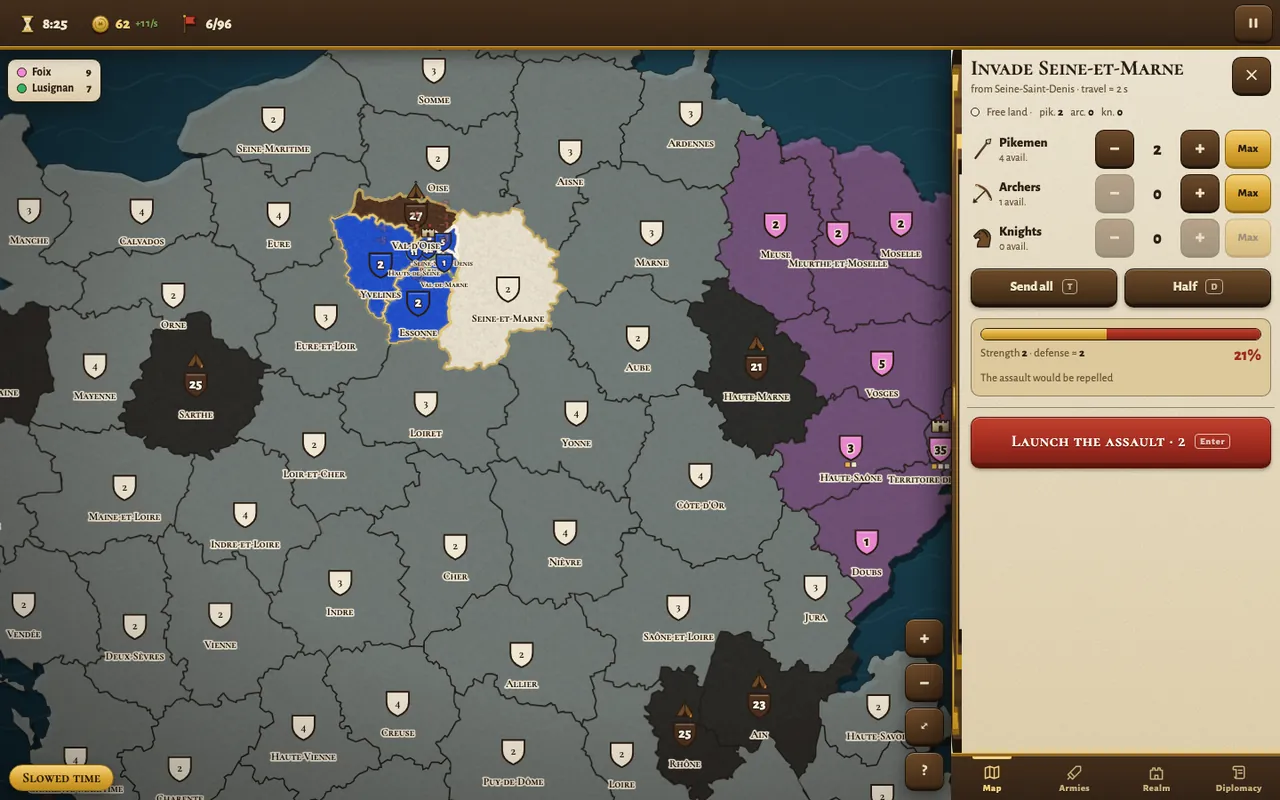
Example: 20 knights attack 30 archers. Attack: 20 × 2.2 × 1.5 = 66. Defense: 30 × 1.8 × 0.5 = 27 (archers are beaten by knights). The territory falls easily. With 20 pikemen instead, the attack would only be 20 × 1 × 0.5 = 10.
Marching speed
An army containing at least one pikeman or archer moves at infantry speed. An army made only of knights moves about 1.8 times faster (46 versus 26 map units per second). The shortest march takes at least 1.2 seconds. Knights alone are therefore ideal to strike a distant target before it grows stronger.
How a battle is resolved
The game adds up the adjusted attack of the whole army and the adjusted defense of the whole garrison, then multiplies the defense by the castle bonus and the region bonus.
- Attacker wins: it loses a share of its soldiers equal to (defense ÷ attack) to the power of 1.15, capped at 95%. At least one soldier survives and occupies the territory.
- Defense holds: the attacking army is wiped out, and the garrison loses a share equal to (attack ÷ defense) to the power of 1.15.
An attack twice as strong as the defense therefore costs about 45% of the army; three times as strong, about 28%.
Buildings
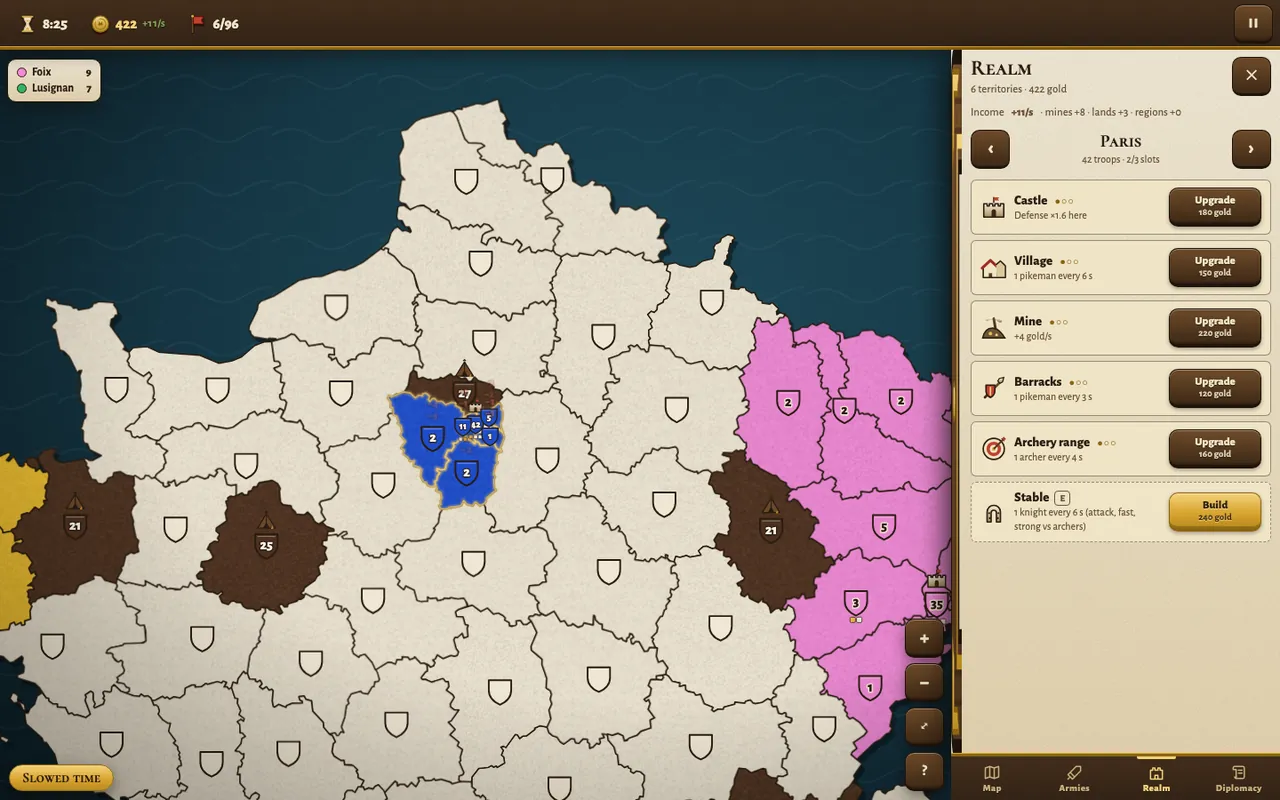
The capital starts with a castle, a village and a mine. Other buildings are bought with gold, from the Realm tab or the Recruit button.
| Building | Cost | Effect at level 1 | Requirement |
|---|---|---|---|
| Castle | — | Territory defense ×1.6 | Capital only |
| Village | — | 1 pikeman every 6 s | Capital only |
| Mine | 220 | +4 gold per second | One per territory |
| Barracks | 120 | 1 pikeman every 3 s | One per territory |
| Archery range | 160 | 1 archer every 4 s | Barracks in the territory |
| Stable | 240 | 1 knight every 6 s | Archery range in the territory |
Three rules frame construction:
- Slots: each territory holds 3 purchased buildings. The capital also keeps its starting mine.
- Military chain: barracks, then archery range, then stable, in the same territory.
- Rising cost: each copy you already own raises the price of the next by 20% of the base price. Your third barracks therefore costs 168 gold. The starting mine is not counted.
Upgrades
Every building goes up to level 3. Reaching level 2 costs the building's base price; reaching level 3 costs twice that. The castle and the village, which have no purchase price, use a base of 180 and 150 gold.
| Level | Production (village, barracks, archery range, stable) | Mine | Castle |
|---|---|---|---|
| 1 | ×1 | 4 gold/s | Defense ×1.6 |
| 2 | ×1.5 | 6 gold/s | Defense ×1.9 |
| 3 | ×2 | 8 gold/s | Defense ×2.2 |
Level 3 barracks therefore train a pikeman every 1.5 seconds, 40 per minute. A territory stops producing when its garrison reaches 250 soldiers: move your troops so nothing is wasted.
Income and bonuses
- Each territory yields 0.5 gold per second. On the Europe map this amount is multiplied by the territory's value, from 0.6 to 1.6 depending on its size.
- Each complete region yields, in gold per second, three quarters of its number of territories rounded up, and multiplies the defense of all its territories by 1.25.
- Razing a barbarian camp pays a 120 gold bounty.
Barbarian camps and free lands
Free lands start with 2 to 4 pikemen and never grow. Barbarian camps start with 8 to 15 pikemen and 2 to 6 archers, and gain one pikeman every 10 seconds while they have fewer than 30 soldiers. Barbarians never attack: they are obstacles, and a source of gold.
To apply these numbers in a game, read the strategy guide.